
Posted By
Marfil Tiles
Published Date
14 September 2026
What happens to Full Body Tiles and surface-printed tiles after years of everyday use?
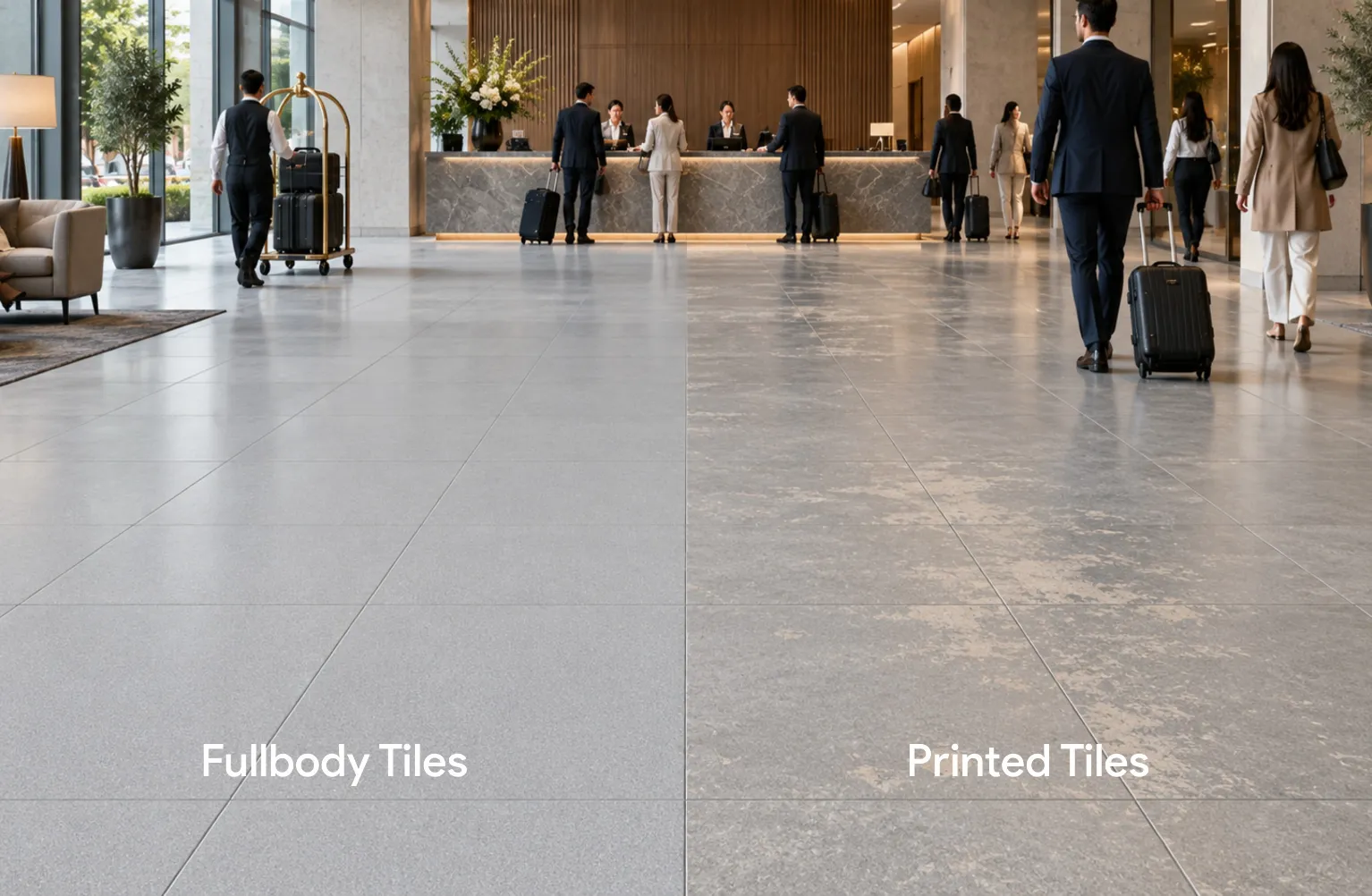
When both tiles are new, the difference may not be obvious. A surface-printed tile can look just as attractive as a Full Body Tile under showroom lighting. The real difference becomes more important after years of foot traffic, cleaning, furniture movement, scratches and occasional edge damage.
Full Body Tiles are manufactured so that the colour and material composition continue through the tile body, rather than relying primarily on a decorative surface. Surface-printed tiles, by comparison, use printing or decorative treatments mainly on the upper surface.
This difference in construction can affect how wear, scratches and minor chips appear over time.
For Indian architects, developers, contractors and commercial project owners, the better question is therefore not simply “Which tile looks better today?” It is:
“Which tile is likely to maintain its appearance and performance as the project ages?”
This guide explains what changes after years of use and when Full Body Tiles may offer a practical advantage over surface-printed alternatives.
The key difference is not simply how much wear a tile can withstand. It is also how that wear appears when it eventually happens. Two tiles may both experience abrasion, but the construction of a Full Body Tile can make scratches, surface wear and minor chips less visually obvious.
With Full Body Tiles, the colour and composition continue through the tile body rather than existing only as a decorative surface.
Surface-printed tiles work differently. Their visual design is primarily created on the upper surface of the tile.
Does this mean one is universally better?
No.
A lightly used residential room does not face the same conditions as a shopping centre entrance or hotel corridor.
The advantage of Full Body Vitrified Tiles becomes more relevant as traffic, abrasion and the expected service life increase.
Consider a corporate reception.
Nobody walks equally across the entire floor. Most people enter through the same door, approach the same desk and follow the same pathway towards the lifts.
Over time, these traffic lanes receive far more abrasion than quieter corners.
On a surface-printed product, substantial wear can eventually affect the decorative layer itself.
With Full Body Tiles, the colour continues through the material, so normal wear does not expose a completely different-looking body underneath.
That distinction is especially valuable in:
This is particularly relevant for high-footfall spaces across India, including shopping malls, hotel lobbies, retail stores, corporate offices, hospitals, educational buildings and public facilities. In busy commercial environments, flooring may experience repeated pedestrian traffic, regular cleaning and frequent movement of furniture or equipment.
This is one of those details nobody discusses during the inauguration.
Then someone drops heavy equipment near the lift.
A tile edge chips.
With a surface-printed tile, the damaged area can sometimes reveal a body colour that contrasts with the decorative surface. A relatively small chip suddenly becomes easy to notice.
Because Full Body Vitrified Tiles carry colour through their structure, minor chips tend to be less visually contrasting.
The damage has not magically disappeared.
It simply attracts less attention.
Across a premium commercial floor, that can make a meaningful difference to how long the installation continues looking well maintained.
“Keep some spare tiles.”
Good advice.
But what happens ten years later?
Can you still find the same design?
Will the new batch match the old floor closely?
And can you replace it without disturbing business operations?
Changing damaged flooring in an occupied hotel, office or showroom can involve moving furniture, restricting access, coordinating contractors and waiting for installation materials to set.
That is why lifecycle planning matters.
A more durable surface can reduce how frequently facility teams need to intervene.
A cheaper tile can produce a lower construction bill.
But project owners do not stop spending when construction ends.
They continue paying for cleaning, maintenance, repairs and replacements.
This is where Full Body Tiles often make stronger commercial sense for demanding applications. The initial product comparison should therefore include expected traffic and long-term maintenance, not simply cost per square foot.
The cheapest tile on the purchase order can become surprisingly expensive when the facility team has to keep dealing with it.
Full Body Tiles can be particularly suitable when the project requires long-term visual consistency and the flooring will experience repeated use.
Consider them when:
For lightly used residential areas, however, a surface-printed tile may still meet the project's requirements. The right choice depends on the application's traffic, design expectations, specification and budget.
| Feature | Full Body Tiles | Surface-Printed Tiles |
| Colour through tile body | Yes | Primarily surface-based |
| Visible effect of wear | Generally less contrasting | Can become more noticeable as surface wears |
| Minor edge chips | Less likely to expose a strongly contrasting body | May reveal a different underlying colour |
| High-traffic suitability | Particularly suitable for demanding applications | Depends on product specification |
| Design options | Stone, concrete, marble, wood and other looks | Wide range of printed designs |
| Long-term appearance | Strong advantage where wear is a concern | Depends on surface finish and usage |
| Maintenance | Generally easy to clean | Generally easy to clean |
| Best suited for | High-traffic, commercial and industrial applications | Residential and varied commercial applications |
Full Body Tiles can offer better long-term visual durability because their colour and composition extend through the tile body. When the surface experiences wear or a minor edge chip occurs, the underlying material is less likely to create a strong colour contrast.
Surface-printed tiles can still be suitable for many residential and commercial applications, but their decorative appearance depends more heavily on the surface layer.
The difference becomes particularly relevant in high-traffic Indian commercial environments, where repeated footfall, cleaning and furniture movement can accelerate visible wear.
For projects where flooring needs to maintain its appearance and performance over years of regular use, Marfil Tiles offers a range of Full Body Tiles designed for residential, commercial and industrial applications.
Project buyers can explore:
A tile should not be judged only by how impressive it looks when it leaves the showroom.
For high-traffic projects, what matters is how the flooring responds to years of footfall, cleaning, furniture movement, scratches and occasional impact. Full Body Tiles offer an important advantage because their colour and composition continue through the tile body, helping wear and minor damage remain less visually contrasting.
For Indian residential, commercial and industrial projects, the right choice should ultimately depend on traffic, application, maintenance expectations, design requirements and long-term value.
Explore Marfil Tiles' Full Body collections to find flooring designed for projects where appearance and long-term performance need to work together.
Full Body Tiles have colour and composition throughout their body, while printed tiles primarily carry their decorative design on the surface.
Because the colour runs through the tile body, everyday abrasion does not remove a separate decorative layer in the same way it can with some surface-finished products.
Yes. They are commonly considered for commercial and industrial areas where repeated traffic and long-term wear are important factors.
They can have a higher initial cost, depending on specification. Buyers should compare lifecycle value, maintenance and replacement requirements along with purchase price.
It depends on traffic and application. For demanding, high-traffic environments, Full Body Vitrified Tiles are often preferred because wear and minor damage remain less visually noticeable.
Because the colour and composition continue through the tile body, a minor chip may be less visually contrasting than it would be on a tile whose decorative appearance is concentrated primarily on the surface. However, the extent of visible damage depends on the tile's colour, construction and depth of the chip.
Latest Insights
15 September 2026
Full Body Tiles Durability: What Affects...
In the quest for sustainable building materials, Fullbody Tiles have emerged as a leading choice for...
23 August 2026
Why Price Per Square Foot Isn’t...
In the quest for sustainable building materials, Fullbody Tiles have emerged as a leading choice for...
22 August 2026
The Hidden Cost of Cheap Flooring:...
In the quest for sustainable building materials, Fullbody Tiles have emerged as a leading choice for...


