
Posted By
Marfil Tiles
Published Date
16 October 2026
Two tile samples can look equally impressive on the table.
Same shine. Similar colour. Both feel premium.
So when one quotation is lower, the obvious question is:
“Why not choose the cheaper one?”
The answer usually appears much later. When there is excessive pedestrian traffic. When the carts take the same route. When the chipping of the corner near the elevator starts happening. When the maintenance crew starts discovering the wear and tear of the most frequented area of the building. That is where the differences between Full Body Vitrified Tiles and Double Charge Tiles arise.
Neither is superior or inferior to the other. The critical question is which one would be more ideal depending on the actual usage of the floor.
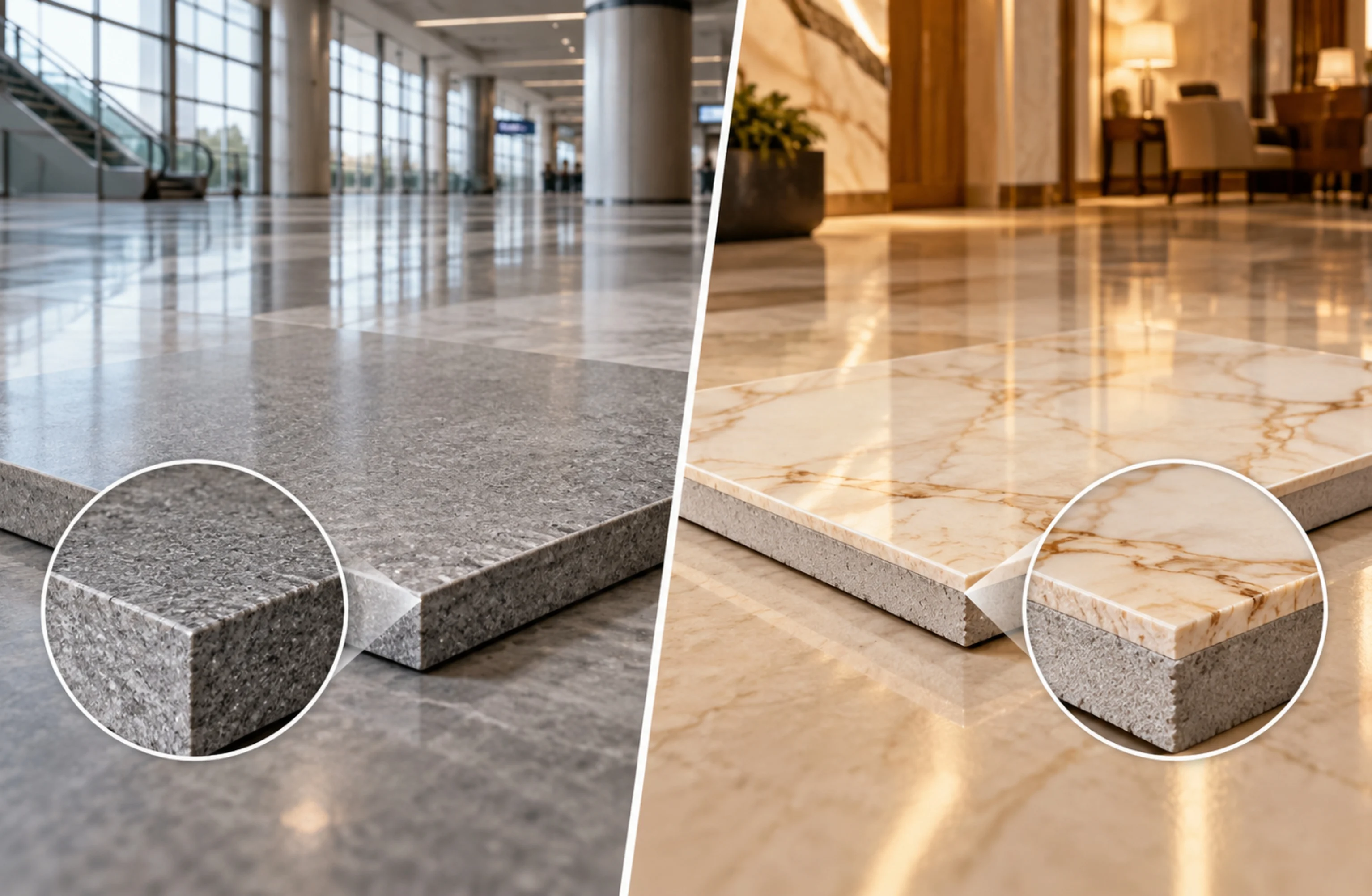
Full Body Vitrified Tiles have colour and composition extending through the tile body, while Double Charge Tiles have a decorative upper layer formed during manufacturing. Full Body Tiles can make minor chips less visually noticeable, whereas Double Charge Tiles offer decorative patterns with a relatively deep surface layer. The right choice depends on traffic, abrasion resistance, finish, installation conditions and project requirements.
A good comparison should go beyond surface design. Construction affects how a tile responds to wear, chips and long-term traffic.
When it comes to Full Body Vitrified Tiles, the whole body contains the same color and composition. Meaning that if you have a chipped edge or worn out surface, the part you see will not stand out much in visual terms. This is not the case for Double Charge Tiles.
Double Charge Tiles come with a thicker decorative layer on the outer part of the surface. It gives it nice marble or stone look, but this layer does not go far in the body of the tile. In cases of light or medium usage, it may serve the purpose. But in a case of heavy duty, it makes a significant difference.
Imagine a mall on opening day. Every part of the floor looks identical. Now fast-forward five years. The corners still look relatively untouched. The entrance does not. Thousands of people have crossed the same area. Cleaning machines have travelled the same path. Trolleys have repeatedly turned at the same junction.
Because Full Body Vitrified Tiles are homogeneous throughout the body, everyday wear is less likely to reveal a completely different-looking layer underneath.
That makes them particularly useful for:
A damaged tile near a hotel reception may only have a tiny chip. But once the inner body contrasts with the surface, everyone notices it. With Full Body Tiles, minor damage tends to blend better because the colour continues through the material.
The chip still exists. It just does not attract the same attention. In premium commercial environments, that can help the floor continue looking more uniform without immediate replacement.
Procurement sees the price once. The facility team sees the floor every day. They deal with scratches, worn traffic routes, damaged sections and replacement work. And replacing a tile inside an operational building is never just about buying another tile. The area may need barricading. Furniture might need moving. Contractors have to return. Matching stock has to be found.
That is why Full Body Vitrified Tiles often make better lifecycle sense in high-use environments. A slightly higher upfront cost can be easier to justify when frequent maintenance and visible wear become less of a concern.
| Factor | Full Body Vitrified Tiles | Double Charge Tiles |
| Construction | Colour and composition extend through the body | Decorative upper layer over a base body |
| Visual appearance | Often uniform or body-coloured; design options vary | Decorative marble, stone and other patterns |
| Minor chips | May be less visually noticeable | May reveal contrasting base material |
| Abrasion resistance | Depends on product specification | Depends on product specification |
| High-traffic use | Suitable when appropriately specified | Can also be suitable when appropriately specified |
| Maintenance | Depends on finish and application | Depends on finish and application |
| Typical applications | Commercial, industrial and public areas | Residential and commercial interiors |
| Selection priority | Body consistency, performance and finish | Decorative appearance, performance and finish |
Full Body and Double Charge Vitrified Tiles should not be compared only by their manufacturing process. Project buyers should also evaluate water absorption, breaking strength, abrasion resistance, surface finish, slip resistance where applicable, dimensional accuracy and installation requirements.
A tile's suitability for heavy traffic depends on its tested performance and the complete flooring system, not simply whether it is Full Body or Double Charge.
Large projects rarely need one flooring specification everywhere. Marfil Tiles offers Full Body and Digital Full Body solutions that allow architects, developers and contractors to choose according to traffic, design and application.
For architects and project buyers choosing flooring for demanding applications, Marfil Tiles offers Full Body Vitrified Tiles across multiple designs, formats and thickness options. Buyers can evaluate the available collections according to expected traffic, surface finish, application requirements and project specifications.
The range includes:
Choose Full Body Vitrified Tiles when the floor needs to handle demanding use while keeping visible wear under control. Explore our catalog now.
Full Body Tiles can be advantageous where through-body colour consistency is important, while Double Charge Tiles offer decorative surface patterns. Both can suit commercial applications when their specifications meet project requirements.
Yes. As a result of their uniform make-up, they can be used in many types of high-traffic public commercial spaces.
Not necessarily. Their decorative layer can withstand regular use, but excessive abrasion or deep damage may affect its appearance. Performance depends on tile quality, finish and operating conditions.
The initial expense can be higher, but lifecycle costs have to be factored in when determining the value of Full Body Tiles.
Examine the tile edge to see whether its colour and composition extend through the body. For confirmation, request the manufacturer's technical specifications and product information.
Latest Insights
15 September 2026
Full Body Tiles Durability: What Affects...
In the quest for sustainable building materials, Fullbody Tiles have emerged as a leading choice for...
14 September 2026
Full Body Tiles vs Surface-Printed Tiles:...
In the quest for sustainable building materials, Fullbody Tiles have emerged as a leading choice for...
23 August 2026
Why Price Per Square Foot Isn’t...
In the quest for sustainable building materials, Fullbody Tiles have emerged as a leading choice for...


